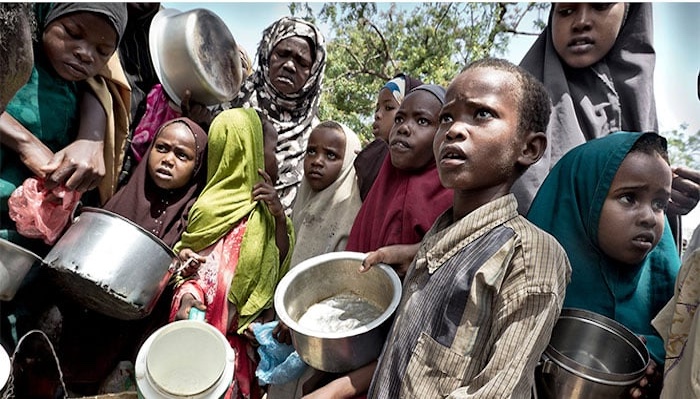
The removal of a fuel subsidy has triggered inflation across Nigeria, leading to food insecurity and spreading desperation across the country, writes Uche Igwe.
Nigeria is facing a hunger challenge as a result of extreme poverty and deepening inequality. According to the World Bank, about 129 million Nigerians, 59 per cent of the population, live in poverty. The country is going through one of its worst economic crises in recent history. Inflation reached 34 per cent in December 2024, a three-decade high. This has had a major effect on food prices. The country ranked 110th out of 127 countries in the Global Hunger Index in 2024 – a level of hunger described as serious. The 2024 Global Report on Food Crises grouped Nigeria alongside countries like Malawi, Chad, and Yemen as facing acute levels of food insecurity.
Removal of fuel subsidies triggered food inflation
The sudden removal of fuel subsidies in 2023 led to an increase in the transportation costs of agricultural produce, which has fuelled inflation. The policy was introduced in 1970 to counter oil shocks by enabling the government to lower the price of petroleum products below the market price and use public resources to pay the difference. Nigeria’s President Bola Ahmed Tinubu described the removal of the policy as a painful but inevitable decision that will put the country on a path of economic revival. In the short term, it has caused the prices of essential goods like rice, bread and vegetables to quadruple, making it difficult for households to put nutritious meals on the table. Food inflation rose to 39.93 per cent in November 2024, according to figures from the National Bureau of Statistics. The country’s expenditure on food imports continues to surge, putting additional pressure on the exchange rate. In 2023 alone, Nigeria spent £7.9 billion on food imports, according to the Africa Development Bank, including £2.3 billion on wheat alone.
Hungry, rampaging Nigerians have broken into several food warehouses, looting them and hijacking food trucks across the country. In December 2024, 67 people died in stampedes across three Nigerian cities as they scrambled to get food at different charity events. Auwal Musa, Director of the Civil Society Legislative Advocacy Centre based in Abuja, attributed the stampedes to the alarming state of hunger and desperation due to bad governance and rising poverty levels.
In February 2024, the Nigerian government ordered the release of 102,000 metric tonnes of grain from its reserve and proposed further importation to augment any shortfall. The Nigerian government introduced a 150-day duty-free window in July 2024 for essential food imports, including maize, husked brown rice and wheat, as part of the Presidential Accelerated Stabilization Advancement Plan. Efforts were also made to replenish the national grain reserves and support small-scale food producers. According to a recent report, the policy has not yielded the expected results. It impacted domestic farmers negatively, who complained of price distortion because they could no longer sell their produce at competitive prices. Akinwumi Adesina, former President of the Africa Development Bank, insists that Nigeria cannot import its way out of food insecurity.
Climate change and conflict
Climate change and the associated unreliable weather patterns, drought, and desertification have already begun to hamper productivity levels and will continue to contribute to food insecurity across the globe. In Nigeria, flooding continues to exacerbate the country’s already deteriorating food security situation. The United Nations Food and Agriculture Organization estimated that the September 2024 flooding in Nigeria destroyed crops and livestock that would have fed 8.5 million Nigerians for six months.
Armed conflict also has a detrimental effect on food security. Exposure to conflict contributes to reduced agricultural production, disruption of the supply chain and price increases due to dysfunctional markets. Persistent violence in the northeastern states hinders food availability and access. Additionally, banditry and kidnapping in other states like Katsina, Sokoto, Kaduna, Plateau, Benue and Niger have precipitated complex security challenges. The historical clashes between farmers and herders have been partly due to competition for land and water resources, which in turn will be made worse by climate change.
The government must strive to improve the policy environment and ensure the coordination of activities of diverse players that operate at different levels of government. As a stop-gap measure, the government should consider providing households with information and inputs that will enable them to produce enough food around their homes to feed their families. Adequate security must be ensured with the collaboration and support of communities while ensuring that infrastructure, like good roads and electricity, is provided.
There is a need for collaborative investment through public-private partnerships in a range of agriculture tools, such as precision farming drones and data analytics. Climate-smart technologies that can help farmers adapt to changing conditions should be considered to promote sustainability. Beyond public relations rhetoric, the Nigerian government should invest in security, agricultural infrastructure, including irrigation systems, storage facilities, transportation networks and processing plants.
The current wave of hunger was exacerbated by a policy decision. The government needs to put the right policies in place to stop things from getting worse.
This piece first appeared in LSE Africa blogs.