Many Nigerians have said their country is descending into a banana republic on account of decades of poor governance, disrespect for the rule of law and so on. But likening a failed state such as Nigeria to a banana republic is disrespectful to banana republics. That said, no ruler has hastened Nigeria’s state collapse more than the incumbent president Bola Tinubu.
His seriously dodgy past with links to the “white heroin” trade in Chicago has led to him being likened to the notorious Colombian drug baron Pablo Escobar. Those links saw Tinubu being caricatured on social media with Nigerian investigative journalist David Hundeyin calling him “Pablo Ecowas”.

There are a few similarities between both men. Tinubu has also been alleged to own coca farms in Colombia.
Escobar also dabbled in politics and was elected to the Colombian Chamber of Deputies in 1982 for a short-lived political career. Tinubu was elected to the Nigerian senate in 1992 before it was dissolved by the dictator Sani Abacha. From 1999, he became the governor of Lagos State for eight years. But his powers on the national scene came when he used his considerable financial clout to deliver the presidency for Muhammadu Buhari in 2015 before replacing Buhari in 2023. This is where he shares more similarities with another Latin American strongman with narcotics links, Manuel Noriega.
Noriega was the unofficial ruler of Panama between 1983 and 1989. As a general in the national guard, he preferred to operate behind the scenes and install his puppets as president, helping them rig elections – just like Tinubu. Noriega was also a CIA “asset” reportedly from 1955. He was trained at the US-run School of the Americas, which was known to be a sort of finishing school for “dictators, death squad operatives, and assassins”. The US turned a blind eye to Noriega’s involvement in drug trafficking, which could well be the case with Tinubu.
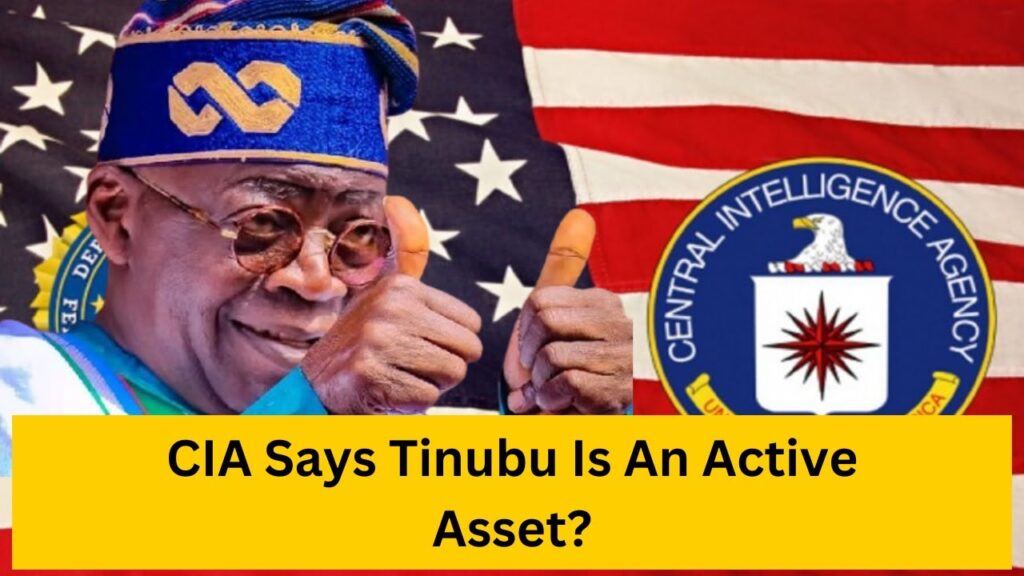
Hundeyin claimed via Twitter that: the CIA effectively confirmed that Nigeria’s sitting president is an active CIA asset. An excerpt from the CIA filing reads: “Human sources can be expected to furnish information to the CIA only when they are confident the CIA can and will do everything in its power to prevent the public disclosure of their cooperation. In the case of a person who has been cooperating with the CIA, official confirmation of that cooperation could cause the targets to take retaliatory action against that person or against their family or friends. It also places in jeopardy every individual with whom the cooperating individual has had contact. Thus, the indiscretion of one source in a chain of intelligence sources can damage an entire spectrum of sources. As such, confirming or denying the existence of records on a particular foreign national, like Tinubu, reasonably could be expected to cause damage to U.S. national security by indicating whether or not the CIA maintained any human intelligence sources related to Tinubu, and identifying any access or lack of access any such sources had to intelligence concerning him.”
As Noriega got more brazen in his despotism, money laundering, providing cover for drug traffickers and murdering opponents, the US continued to back him and at one point he said, he was helping the US authorities combat drug dealers.
In the end, he became a bit of an international embarrassment for then President George H Bush and he was asked to resign, but he refused, threatening to deal severely with any US meddling in his country. Triggered by the killing of US military personnel based in the Panama Canal zone, Bush ordered a military invasion of the country in December 1989. Noriega was captured in January 1990 and whisked to the US where he stood trial in Miami and was sentenced to 40 years in prison for drug trafficking, racketeering and money laundering. He was extradited to France on money laundering charges in 2010 and sentenced to seven years in prison. He returned to jail in Panama in 2011 for sentences totalling 60 years in his absence for human rights abuses during his reign. By this time age and a brain tumour had caught up with him and he died at 83 in 2017.
There seems to be a lesson here for Tinubu, with the striking parallels between his story and Noriega’s, including money laundering links to France, where Tinubu has a hideout. The US/CIA has a long record of working with some pretty despicable rogues only to turn against them. This trait is captured in the American saying “he may be a bastard, but he’s our bastard”. The fate of those “bastards” whenever they outlive their usefulness to the US is remarkably similar to Noriega’s.
While it remains very unlikely that the Nigerian justice system would make Tinubu pay for his crimes, going by how it ended for Noriega, it may be Tinubu’s US “friends” that would eventually be his undoing, considering that former Economic and Financial Crimes Commission (EFCC) boss Nuhu Ribadu said Tinubu’s “criminal case is of international dimension”.