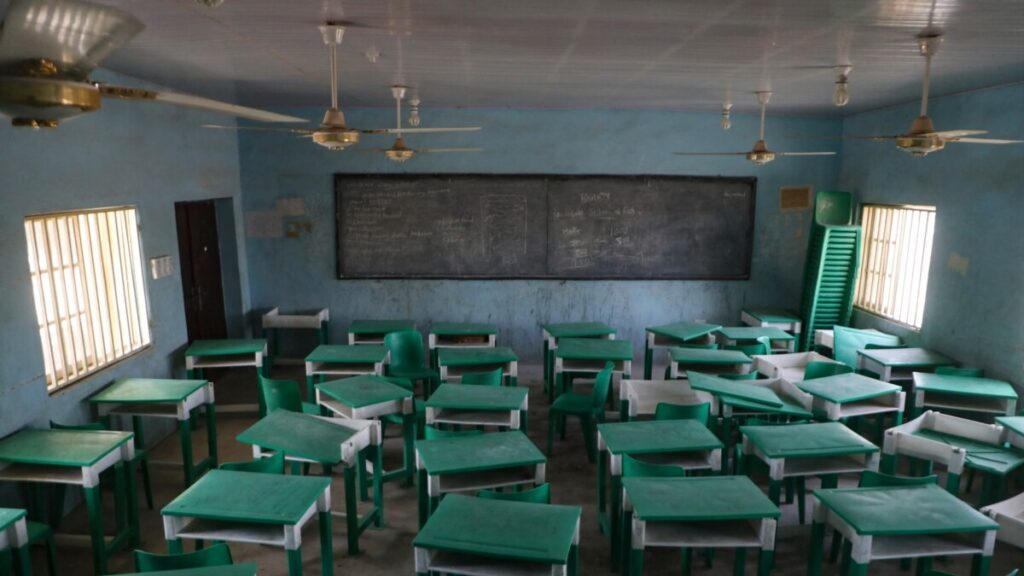
The future education of an estimated 2.8 million children in West and Central Africa is in jeopardy due to conflicts. The situation is particularly dire in Nigeria and Cameroon.
Ongoing conflicts across West and Central Africa have disrupted the education of around 2.8 million children, according to a recent United Nations report. Over 14,000 schools in the regions were closed by the second quarter of 2024 — 1,000 more schools than the previous year.
The global number of out-of-school children totals 250 million, according to 2023 UNESCO figures. Sub-Saharan Africa accounts for close to 30% of all out-of-school children around the world, and the number is on the rise.
Armed conflicts have ravaged communities and displaced many people.
“The key challenge they are facing then is not related to getting an education, but rather how to access basic survival needs — food, water, and medical services,” Dr. Ibrahim Baba Shatambaya, a political science lecturer at Usmanu Danfodiyo University Sokoto, Nigeria, told DW.
Then there is the issue of violence directly affecting schools. “Education is under siege in West and Central Africa. The deliberate targeting of schools and the systemic denial of education because of conflict is nothing short of a catastrophe,” said Hassane Hamadou, Norwegian Refugee Council regional director.
Countries like Nigeria, Cameroon, Burkina Faso, Mali, and the Democratic Republic of Congo are bearing the brunt of this crisis as schools are repeatedly attacked by armed groups.
Devastation in Nigeria
Nigeria, Africa’s most populous country, is facing a severe education crisis. Over 15.23 million children are out of school, according to UNESCO.
The problem is largely affecting the northern part of the country, which has been besieged by the Boko Haram insurgency and kidnapping crisis in the past decades.
The regional disparity is confirmed in figures showing that the Northwest and Northeast regions of Nigeria count 8.04 million and 5.06 million out-of-school children, respectively, compared to 2.58 million in southern Nigeria.
“In the case of Northwest Nigeria, kidnappings, and other forms of criminality, have made that part of the country unstable,” Shatambaya said.
The reasons for the prevalence of conflicts in these regions are multifaceted, says Dr. Michael Ndimancho, a political analyst at the University of Douala in Cameroon.
“When you look at countries like Nigeria and Cameroon … there are many historical issues at play,” he said, mentioning the example of the Boko Haram insurgency. “And in West and Central Africa, you have the problem of borders which are not only large but very porous.”
For Shatambaya, it is more a question of governance in Nigeria at the local, state and federal levels. He says government measures so far have not been adequate. “Each of these actors has a stake in managing crises associated with conflicts and other social ills like the forced movement of people,” he said.