
Al Jazeera’s Inside Story attempted to diagnose the “root cause” of the current malaise afflicting Nigeria under the regime of Bola Tinubu. The illness was summed up as “corruption, economic mismanagement and a weak currency”.
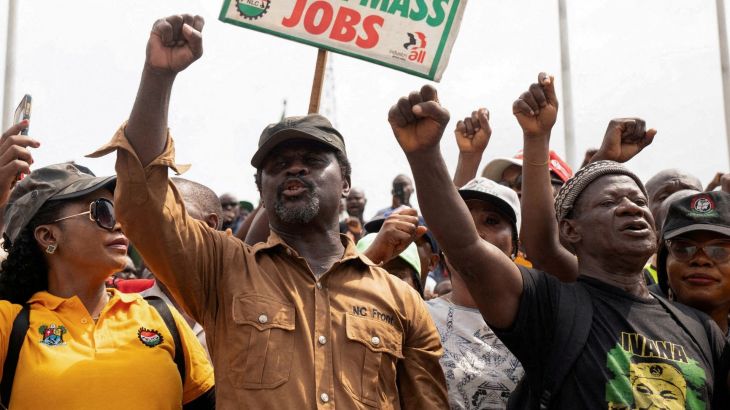
While these problems didn’t start with Tinubu’s year-old regime, union leaders blame his “reforms” for making things worse, with the country witnessing the highest level of inflation in 30 years.
The guests on the programme, with the exception of Hamzat Lawal, from the NGO Connected Development, were as disappointing as the Nigerian economy, parroting the official line and voodoo economics theories about the alleged benefits of liberalising the currency and and removing the fuel subsidy.
Amaka Anku, from the Euroasia Group, demonstrated how divorced from Nigerian reality she was all the way from Washington when after rightly complaining about the cost of the subsidy – about $10bn a year – she argued that it couldn’t benefit that many Nigerians as not that many had cars. It’s shocking that a so-called expert didn’t know that the cost of petrol affects both motorists and those that use public transport, and has a knock-on effect on prices of goods and services.
Lawal seemed exasperated by it all, pointing out that some of them were “living in a bubble”. He questioned how it could be argued that any savings from not subsidising fuel could be spent on the people when corruption and the high maintenance of political office holders meant very little was trickling down.
The other guest Khalil Halilu rightly pointed out that Nigeria wasn’t producing much including not refining its own petroleum and failing to industrialise for decades was coming back to haunt the country.
Anku was correct when she said that all three major candidates in the last presidential election said they would do exactly what Tinubu was doing now in terms of not pegging the naira artificially and ending the fuel subsidy. She thought this was an argument in favour of the policies. In reality, it just demonstrated that orthodox neoliberal economics is the only game in town among Nigeria’s ruling elite. They have perfected the art of doing the same things and expecting different results.
All three guest veered off course when they claimed that “communication” would help make things better. Anku said “reform is painful” and the government had to carry people along through better messaging. That’s just plain ridiculous. As one union activist said recently, “a hungry man is an angry man”. What a “hungry man” needs is food not food for thought.


