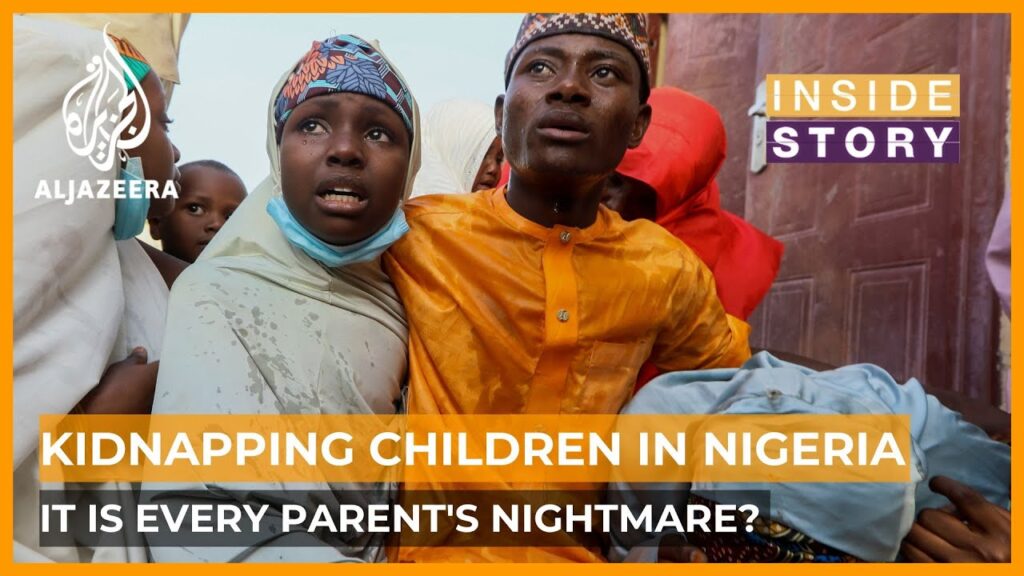
Nearly 300 students and some of their teachers were kidnapped by gunmen in Kuriga, Kaduna State in Nigeria yesterday morning. As parents and relatives protested government failure to keep their children safe, Al Jazeera’s Inside Story tried to address why this problem can’t seem to go away in the country.
Those relatives demonstrating asked “where is the president, where is the governor”. But presenter Hashem Ahelbarra offered that the army is spread thin dealing with security challenges all over the country. 10 years since the abduction of the Chibok girls to huge international outcry, the problem was still happening, with many regions of the country rife with lawlessness.
One of the panellists, Kemi Okenyodo – Founder and executive director, Partners West Africa, agreed that many parts of the country were ungoverned. Another guest, Sadeeq Garba Shehu, a security and defence consultant, said that all levels of government were to blame. He emphasised that there was no coordination between those tasked with securing lives and property, no telephone communication in the area, and no police station in the vicinity. It took about four hours after the incident before government agencies became aware of the crime. Shehu said that the school had no perimeter fence and this was not peculiar because that was the case with most public schools in the country.
Okenyodo suggested that a military response was a “kneejerk approach”. Insecurity was caused by failure of governance. Local government administration was missing in most parts of the country because there have been no local government elections for years, resulting in the governance structure at local government level being “eroded”.
She said there was no systematic approach to addressing the security challenges and military deployment won’t address the problem.
The third guest, Bulama Bukarti, a Senior Fellow at the Tony Blair Institute for Global Change, stated that there are 30,000 “bandits wreaking havoc” and they have “taken over hundreds of villages” especially in the northwest. This was the 74th attack on a school since Chibok. 80% of the Nigerian army was involved in dealing with domestic issues, with not enough attention being paid to problems at Nigeria’s borders. The failure of the police means the military had to be involved. The problem with the police is highlighted by the fact that 40% of officers were deployed in administrative duties or VIP protection.
With Nigeria’s VIPs protected, it’s no surprise that there is little effort in providing protection for the rest of the population.