They say in politics you need to be able to count. But winning the next Nigerian presidential election will require more than combining the vote share of two opposition parties, argues Onyedikachi Madueke.
On 2 July 2025, the African Democratic Coalition (ADC) was unveiled as a new umbrella platform uniting Nigeria’s leading opposition figures. Its goal is to unseat President Bola Tinubu in the 2027 general election.
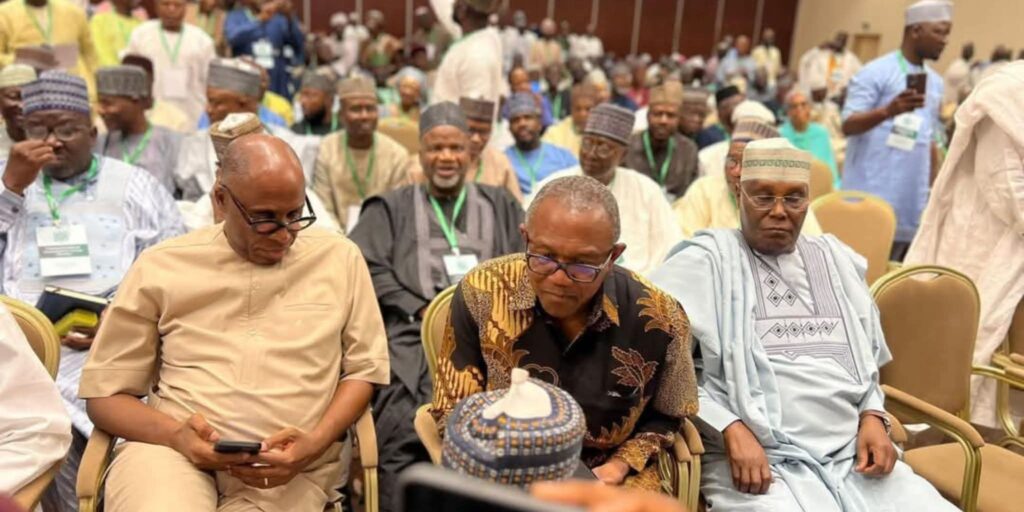
At the heart of this alliance are a group of influential political figures: former Vice President Atiku Abubakar, Labour Party’s 2023 presidential candidate Peter Obi, former Kaduna State Governor Nasir El-Rufai, and several other former governors, cabinet members, and serving parliamentarians across the political divisions of Nigeria.
Unsurprisingly, many observers are drawing parallels with the birth of the ruling All Progressive Congress (APC), a coalition that brought previous president Muhammadu Buhari to power, deposing a sitting president in 2015. Given the weight of personalities involved, some believe the ADC could replicate that historic upset. After all, Atiku and Obi pulled over 12 million combined votes in 2023, more than Tinubu’s winning 8 million.
However, political math doesn’t always translate into electoral victory. Here are some reasons why the ADC might find the road to 2027 bumpier than expected.
From reluctant president to power strategist
The 2015 APC victory was made easier by the leadership style of then-President Goodluck Jonathan. Seen as mild-mannered and not obsessed with power, Jonathan was described as a reluctant politician whose rise seemed more accidental than deliberate. Even during the heated 2015 election, he famously told supporters not to rig on his behalf and declared, “My ambition is not worth the blood of any Nigerian.” Some saw this as a weakness; others saw it as rare statesmanship.
President Tinubu, by contrast, is a seasoned power player. After backing Buhari’s rise in 2015, Tinubu expected to be next in line. When that support didn’t materialise, he went full throttle, famously declaring “Èmi l’òkàn” (“It’s my turn”) and describing the presidency as his “lifelong ambition.” His 2023 campaign was built on the backing of a political network he spent decades building. This included governors, ministers, and loyal protégés. Any coalition facing him in 2027 isn’t just challenging a candidate; it’s going up against a deeply entrenched political machine.
Institutional capture vs democratic restraint
Another key difference between 2015 and now is in the state of Nigeria’s democratic institutions. Jonathan was widely viewed as a president who respected institutional independence. Jonathan rejected the pressure to replace the electoral chief to brighten his chances of winning the 2015 election.
Under Tinubu, however, concerns about state capture are growing. Critics argue that Tinubu is positioning his loyalists in strategic institutions like the judiciary, police, and INEC ahead of the next election. The current Inspector General of Police, who was once Tinubu’s aide when he was Lagos Governor, remains in office despite reaching retirement age. As a popular Nigerian lawyer puts it: ‘Tinubu does not need Nigerians votes to be president, he needs willing judges and INEC.’ The electoral commission, too, has come under fire. In 2023, ex-Minister Rotimi Amaechi alleged that a Tinubu-aligned cabal had hijacked the commission. Some Resident Electoral Commissioners reportedly have ties to the ruling party. The judiciary hasn’t been spared either. Critics point to questionable rulings in politically sensitive cases, fuelling fears of executive interference in the courts.
Unlike Jonathan, who let institutions operate freely, even to his political detriment, Tinubu appears more willing to consolidate control. That could make a fair contest in 2027 harder to guarantee.
Political weight then versus now
The APC in 2015 wasn’t just a coalition of big names; it was a coalition of sitting power. Sixteen governors from influential states joined the APC, along with nearly half the House of Representatives and dozens of senators. This gave the APC both political clout and logistical firepower. The ADC in 2025 doesn’t have that kind of muscle. While it boasts heavyweight figures with popular name recognition, it lacks a single incumbent governor. That’s no small issue. In Nigerian elections, governors often decide outcomes in their states, mobilising voters, controlling local party structures, and sometimes directing results.
To make matters worse, legal battles, factionalism, and other internal cracks in the main opposition Peoples Democratic Party (PDP) and Labour Party are holding back their ADC coalition. Unlike 2013, when APC surged on the back of PDP defections, currently, most disenchanted politicians from the PDP and Labour Party are joining the ruling APC, not the opposition coalition, ADC. The recent defections to the ruling party are largely driven by resource access, bandwagon effect, political survival, and to avoid political persecution, which opposition leaders often face in Nigeria.
Fragile foundation: an old party with new problems
The APC was born in 2013, with no legacy baggage, no infighting. The ADC, on the other hand, is an existing party formed in 2005 that never gained national traction, and how now been thrust into the national spotlight. It’s already showing signs of internal division. Just days after the new coalition was announced, a faction of the ADC rejected it, claiming it hadn’t agreed to the alliance. That’s a red flag. These internal disputes open the door for legal challenges that could paralyse the coalition. Contention over who will emerge as ADC flagbearer in 2027 may further polarise the party. Unless the ADC resolves its internal conflicts swiftly and convincingly, it will struggle to present a united front.
The ADC coalition has ignited fresh political excitement, and its leaders command serious public support. But elections are won with more than names and numbers. Unlike in 2015, the opposition now faces an incumbent who is not only fiercely ambitious but also deeply embedded within Nigeria’s political and institutional structures.
The ADC faces formidable obstacles. Without urgent action to unify its ranks, expand its base, and restore public trust in the system, the dream of replicating the APC’s 2015 success may remain just that, a dream.
This article was first published in the LSE Africa blog.