
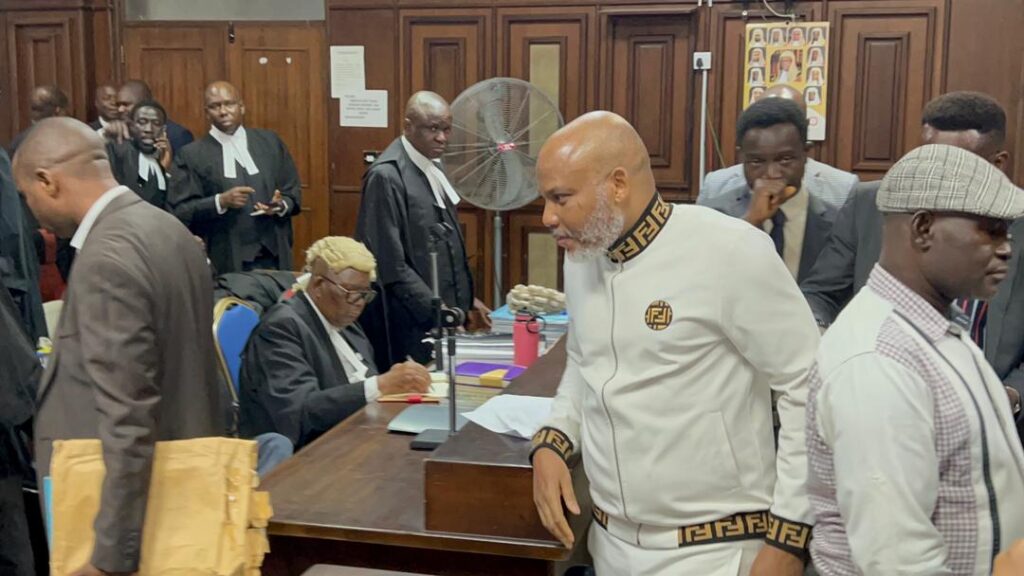
DW, the German public service channel posed a question today whether the detained separatist leader Nnamdi Kanu should be considered as a terrorist threatening the security of Nigeria or a political prisoner.
Nnamdi Kanu, the leader of the proscribed Indigenous People of Biafra (IPOB), proscribed by the Nigerian authorities as a terrorist organisation, while advocating the secession of the southeast region of the country, was abducted in Kenya more than four years ago, and his trial in Nigeria’s notoriously slow and discredited judicial system has faced long delays.
Views on Kanu have polarised the country along ethnic lines. Most of his support comes from his Igbo ethnic group, with his supporters seeing him as a prisoner of conscience being punished for advocating for a Biafran republic being carved out Nigeria. The last attempt to to create Biafra ended in a brutal civil war between 1967 and 1970.
Kanu’s supporters tend to believe that he’s being treated differently because he is Igbo, while amnesty has been granted to Boko Haram terrorists alleged to have committed worse crimes. They think such treatment should be extended to Kanu with a political solution to the judicial impasse.
This sentiment is echoed by human rights lawyer Frank Tiete who argued on DW that if the case against was clear-cut, he would have been convicted on the basis of the evidence. The fact that it has dragged on so long suggests that the evidence against him isn’t strong enough and a political solution would be the sensible way out. Adamu Garba, a member of the ruling All Progressives Congress, was also in favour of a political solution, considering President Bola Tinubu has granted amnesty to others in different circumstances.
Some commentators felt that the Kanu case was no longer a courtroom matter and that he was being held for political reasons. In this sense, holding him has done little to reduce tension or improve security in the southeast.


