
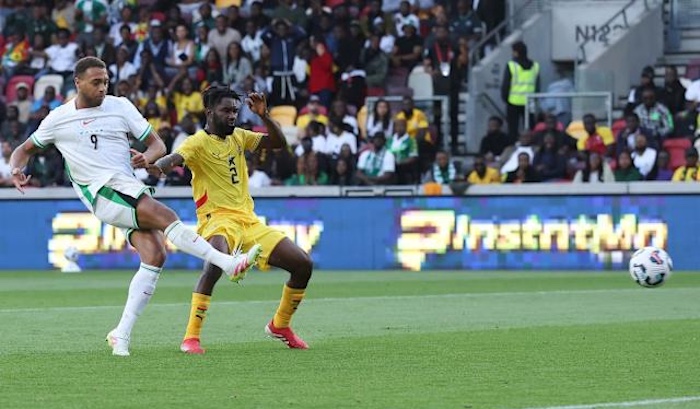
There’s no such thing as a friendly match between Nigeria and Ghana. So the encounter between the West African footballing powerhouses in West London yesterday evening, while officially labelled as a friendly under the auspices of the “Unity Cup”, had a lot more at stake, starting with bragging rights.
Both countries love to claim superiority over the other far beyond the football pitch – from who makes the best jollof rice to who pioneered the Afrobeats music genre to endless bantering on social media. The rivalry, while eternal, is largely good-natured as was seen among the fans that descended on Brentford’s Gtech Community Stadium. Friends arrived together in Ghana and Nigeria colours while some Ghanaians sat among Nigerian fans and vice versa. Incidentally, the stadium food includes jollof rice, but there wasn’t time before kickoff to check if it was Nigerian or Ghanaian jollof.

Some Nigerian fans may have arrived with trepidation, considering the last time the two sides met at Brentford, then at the old Griffin Park in 2007. The 4-1 mauling of Nigeria went into social media folklore as the “Brentford Massacre”. The last time Nigeria had lost to Ghana before that defeat was 15 years before. They would go on a losing streak for three games after Brentford, followed by three draws, which included a 1-1 draw in 2022 in Nigeria that meant Ghana qualified for the World Cup in Qatar on the away goals rule at the expense of their rivals.
The pain of losing out to Ghana in World Cup qualification added more sauce to the jollof derby yesterday, and the Nigerians took the initiative in the first half against a timid Ghana. Glasgow Rangers striker Cyriel Dessers took advantage of a rare start for Nigeria in the absence of Victor Osimhen to hustle and harry the Ghana defence most game. Sodiq Ismaila of Remo Stars, impressed at rightback in his second game for his country and found Dessers, who controlled and finished sharply after 14 minutes. Five minutes later Semi Ajayi, who was imperious at centre back doubled Nigeria’s lead with a header from Samuel Chukwueze’s cross.
The Nigerians were coasting by now and should have been 4-0 up before the break if Dessers was a bit sharper. Frank Onyeka nearly scored with a deflected shot just before the halftime and was dominant in midfield alongside Wilfred Ndidi. This was followed by a dribble and a low drive from Ndidi which was cleared off the line.
Maybe it was pride that inspired Ghana after the break or complacency from the Nigerians, but Ghana, missing West Ham’s Mohammed Kudus and Bournemouth’s Antoine Semenyo, both of whom would have given the Nigerian defence a lot more to think about, came out all guns blazing in the second half. Jordan Ayew’s influence also started growing, while Stanley Nwabali in goal for Nigeria didn’t seem to ooze with his usual confidence.
Ahmed Musa, Moses Simon and Kelechi Iheanacho were brought on by Nigeria coach Eric Chelle on the hour in an attempt to regain the initiative, but only Simon had an impact with his dribbling skills. Surely, Musa and Iheanacho should have the curtains drawn on their international careers.
Ghana’s dominant display in the second half paid off when the best move of the game saw Brandon Thomas-Asante finish off glorious combinations with a neat side-foot for his first goal for Ghana.
Heroics from Nwabali prevented a Ghana leveller and meant a win for Nigeria, which would have been immensely satisfying for their fans as they danced to Afrobeats music from the stadium’s loudspeakers at the final whistle. The banter with fans continued as they made their way out of the ground. A bunch of crestfallen Ghanaian women responded to Nigerian taunts by saying “at least, we’re going to the World Cup”. Ghana sits three points clear of the 2026 World Cup qualifying group, while Nigeria is fourth in their group and almost certain not to qualify.


