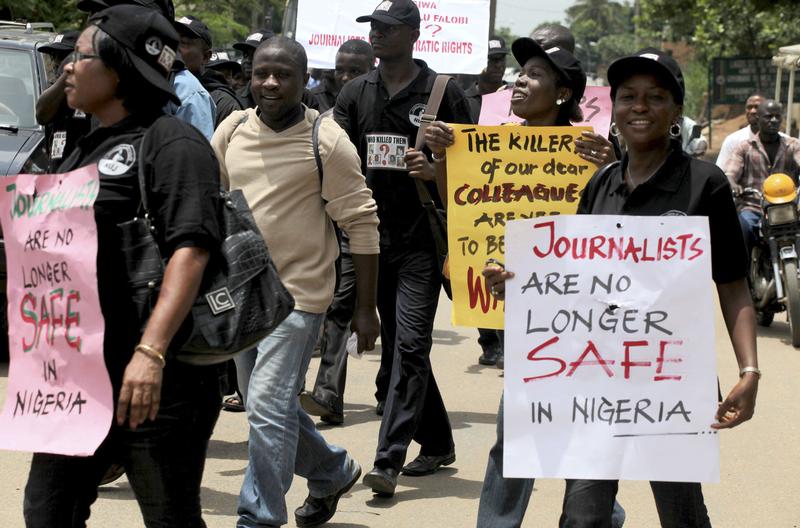
Death threats, kidnapping, unlawful detention, torture and assassination are some of the crimes being committed against journalists in Nigeria, according to a recent report. Another recent report details how the police and politicians are responsible for 70% of these harassment cases.
They point to the increased level of threats that Nigerian journalists endure in their fourth estate role, serving as the voice of the people and holding government to account.
This isn’t new. The harassment of journalists is baked into Nigerian history. But today journalists are also attracting online threats and harassment from members of the public.
I teach and research media and politics, with a focus on online journalism in Nigeria. What’s clear is that the digital age has brought with it a complex relationship not just between journalists and the state, but also with citizens.
All these parties need to turn down the heat, in the interests of free and fair information, particularly in a young democracy like Nigeria.
A long history of violence
The history of Nigerian journalism is characterised by violence from British colonial powers, from 1859 when the first newspaper was established, and also from indigenous politicians. There’s always been a suspicion that a free press could empower ordinary citizens and cause a shift in the power base.
This isn’t unfounded. Journalism contributed to ending colonialism. But, after independence in 1960, the political class feared that an unfettered press would be difficult to control. Particularly when the country came under oppressive military rule from 1966 to 1999.
There was always a fair amount of goodwill towards the press from citizens. But the ownership and control of major media houses by prominent Nigerian politicians, alongside the rise of social media, has changed the picture.
The public used to act as the buffer for journalists, defending them from the attacks of government officials. Now some Nigerians have joined in attacking and harassing journalists in Nigeria.
Online harassment
We know that journalists in Nigeria under-report the harassment they receive. Many don’t view acute forms of harassment – verbal abuse, online disrespect and maltreatment – as an issue. One of our studies found they regard this as mere online banter, verbal sparring and attention seeking. But dismissing harassment doesn’t make it go away or stop. It just makes it worse in frequency and form.
Our studies indicate that online harassment of journalists is prevalent and escalating. This type of harassment is usually sustained and it often moves from one social media platform to another.
In some cases, it spills from online to offline. The burning of the Television Continental station in Lagos in 2020 is just one example. The harassment is usually personal. Threats to the lives and safety of journalists are becoming common.
Data Boys and corruption
Nigerian journalists have reported that the harassers particularly target investigative and political reports, as well as perceived unethical conduct by journalists.
The result is that political reporting is becoming difficult. A critical report about a politician makes the journalist an enemy of the politician. The politician will then unleash their supporters and paid influencers (known as “Data Boys”) to harass and hassle the journalist.
The Data Boys phenomenon as we know it today began during Nigeria’s 2015 general elections. Data Boys are groups of young people on a politician’s payroll. They help to promote the politician’s image online and generally do their bidding. The politician sends them money to buy internet data and shares promotional “news” about themself. The Data Boys are also paid to attack any perceived enemy of the politician.
It’s an increasingly successful political tactic in Nigeria. As a result, journalists have started censoring themselves.
Data Boys aside, we asked ordinary Nigerians who reported engaging in online harassment why they picked on journalists. They indicated that perceived journalistic malpractice was their main reason. They accused journalists of being part of the problem because they believed many were corrupt and in the pay of politicians. Adding fuel to the fire is that Nigerian politicians are also often media owners.
Some solutions
One of the reasons that a culture of harassment continues is the failure of law enforcement. Those who harass journalists are not made to account for their actions. Strengthening harassment laws in Nigeria would give law enforcement the tools needed to curb it.
There are no explicit laws around online harassment in Nigeria, just sexual and physical assault laws. This has to change if journalists are to be protected. All respondents in our studies, both journalists and the public, highlighted the law as a cardinal factor to fight harassment.
Another solution is that journalists need to be accountable, transparent and ethical. Journalists themselves have raised these concerns about their profession.
Yet in our studies journalists did not highlight transparency or an improved code of conduct as ways to improve the harassment situation in Nigeria.
By Temple Uwalaka. A version of this piece first appeared in The Conversation.